Dependabot alternatives: which ones reduce the noise, and how
Dependabot is free and built into GitHub, but a lot of teams look for a Dependabot alternative once the alert queue grows out of control. Security alerts stack up, pull requests open faster than anyone reviews them, and nothing says which alert deserves an afternoon.
In one twelve week period, Dependabot raised 243 alerts on three of our production repositories, 166 of them Critical or High. We scored every alert for risk, and found not one needed fixing that day. I expected at least a few.
Switching update bots moves the pull requests around. It does not tell you which alert matters and is worth your time. These are the alternatives that do, starting with the one we build.
1. Reachable Risk (k9) vs Dependabot
Reachable Risk triages Dependabot's alerts and answers the question: does this alert matter in your code? Your coding agent reads the alert and your code and reports whether the vulnerable code is reachable, with a named basis: a tool confirmed it, the module is never loaded, no path from an entry point reaches it, only first-party input reaches it, or undetermined. k9 adds exploitation evidence (VulnCheck KEV and EPSS) and the asset context you declared, applies a risk scoring rubric, and returns one of four verdicts per alert per execution context: Fix Today, Review, Schedule or Defer. Every verdict is returned with: its rationale, the three factors and their confidence, the floors it triggered, and the evidence. So a deferral is a record a reviewer can disagree with, not a shrug.
Why use it instead of Dependabot alone: Dependabot says a package is vulnerable. Reachable Risk says whether that is a risk in your application and writes down why.
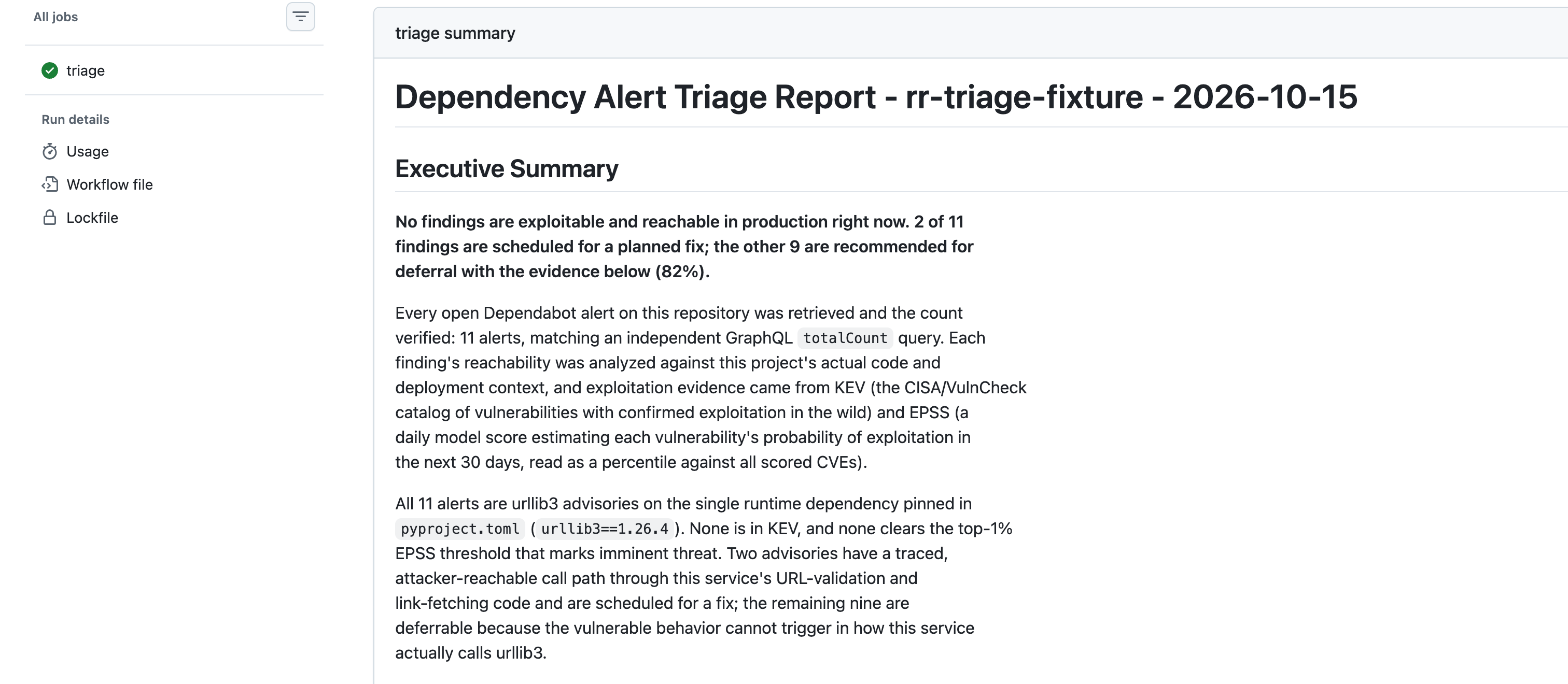
From the published NetBox sample report: the same advisory, CVE-2026-45409 in the idna package, got two different verdicts in the same repository. In netbox-web it was reachable through the RSS dashboard widget, so it was scheduled for a fix. In netbox-worker it was reachable only with first-party input, so it was deferred, with that reason recorded. One advisory, two execution contexts, two correct answers. Severity alone would have given it one.
Across the five sample reports we publish, between 82% and 97% of the alerts scored came back as a deferral with its evidence attached. An alert scored in more than one execution context is counted once, under its most urgent verdict:
| Sample | Ecosystem | Alerts scored | Deferred |
|---|---|---|---|
| Redash | Python and JavaScript | 272 | 243 (89%) |
| NetBox | Python | 11 | 9 (82%) |
| Harbor | Go | 22 | 21 (95%) |
| JupyterLab | JavaScript | 66 | 64 (97%) |
| PetClinic | Java | 691 | 580 (84%) |
We build it, so you can read the samples instead of taking our word for it.
It runs wherever your agent runs. On GitHub, the Reachable Risk Triage Action scores every open Dependabot alert on a schedule, publishes the report, and opens a tested fix pull request only for a Fix Today verdict, or a Schedule verdict whose fixed release is at least 7 days old, after your tests pass on the bumped branch. It never merges or dismisses anything. From Claude Code or any other MCP client, the k9 MCP server does the same scoring interactively; it is listed in the Claude connectors directory.
Reachable Risk Professional is $10 a month for 1,000 alerts, with a 7-day trial. There is no sales call.
2. Dependabot, configured for less noise
Dependabot is three features under one name, each with its own switch:
- Alerts tell you a dependency in your dependency graph has a known vulnerability, free on every plan.
- Security updates open a pull request for every open alert with a patch available.
- Version updates open pull requests to keep dependencies current whether or not they are vulnerable, driven by
dependabot.yml.
Most alternatives replace the second and third feature. But the noise starts in the first.
Dependabot noise starts with alerts for a mechanical reason. Dependabot files one alert per advisory per vulnerable package entry in each manifest or lock file. Then it rates each alert by the externally-defined advisory severity. In one week, three advisories in brace-expansion became 30 alerts in one of our repositories: five lockfiles, two copies of the package in each, one alert per advisory per copy. The same three facts, filed ten times each. And each alert says the package is vulnerable, not whether the vulnerable code can run in your application with attacker input.
Before switching update tools, see what Dependabot configuration can do. It costs nothing.
- Auto-triage rules: GitHub ships presets, one of which auto-dismisses certain low-impact alerts in development-scoped npm dependencies. Custom rules match "targeted metadata, such as severity, package name, CWE, and more" and can dismiss, snooze, or choose which alerts get a pull request. That's free on public repositories. Private repositories need GitHub Code Security on a Team or Enterprise plan.
- Groups:
groupsindependabot.ymlcombine matching updates into one pull request. Security and version updates are never grouped together. - Pull request limits:
open-pull-requests-limit: 0stops version-update PRs for an ecosystem; that is what we run. Security-update PRs have a separate fixed limit of ten. - Cooldown: Version updates wait three days after a release by default. Security updates do not wait.
- Reachability analysis: In public preview as of this writing for JavaScript and TypeScript repositories with a lockfile, on GitHub Enterprise Cloud only. It adds a Reachable, Potentially reachable or Unreachable label with the call path as evidence. You still decide whether reachability matters for that alert.
Where Reachable Risk differs: The rules act on what the advisory says about itself, not the risk of the advisory in your software and deployment scenario. A rule can dismiss every Low in a dev dependency. It cannot tell you that the High in brace-expansion only runs during cdk synth on a build runner with no attacker-controlled input, which is the fact that decides what to do about it. GitHub's auto-triage rules documentation covers the rest.
3. Renovate vs Dependabot
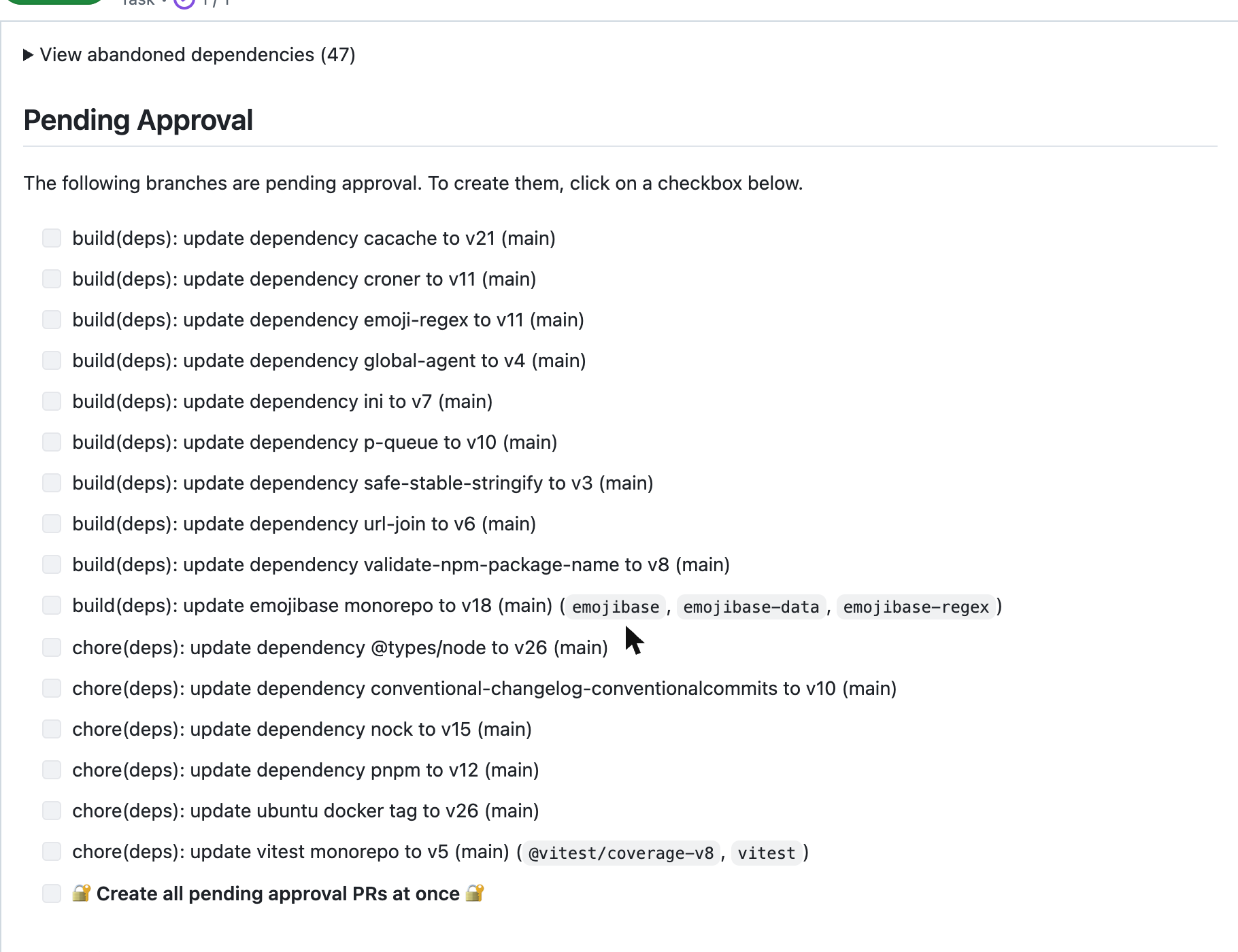
Renovate is a common Dependabot alternative, and it is a better update bot in several ways: more platforms, grouping presets, release-age delays, automerge, and a dashboard issue listing every pending update. Its own bot comparison states the differences plainly:
| Renovate | Dependabot | |
|---|---|---|
| Platforms | Azure, Bitbucket, Forgejo, Gitea, GitHub, GitLab, SCM-Manager | GitHub (and Azure DevOps, per the same table) |
| Dependency dashboard | Yes | No |
| Grouped updates | Yes, community groups or your own | Yes, manual or automatic |
| Scheduling | Runs as often as allowed; configurable | Daily, weekly, monthly, quarterly, semiannually, yearly or cron |
| Compatibility signal | Four badges: age, adoption, passing, confidence | One compatibility score |
| Built into GitHub | No; app or self-hosted | Yes |
| License | AGPL (Mend's hosted editions use a EULA) | MIT |
Pick Renovate if you are on GitLab, Bitbucket or Azure, if you want one dashboard listing every pending update, or if you want fine-grained grouping and minimumReleaseAge delays. Pick Dependabot if you want zero setup on GitHub.
The security alerts come from the same place either way: on GitHub, Renovate's vulnerabilityAlerts feature reads Dependabot's alerts, and off GitHub its experimental OSV mode checks direct dependencies only.
On prioritization, Renovate's documentation names no vulnerability signal. Vulnerability pull requests "skip the line" past your schedule and concurrency limits by default, which treats every vulnerability as equally urgent. Merge Confidence, the signal Renovate does compute, scores a release's age, adoption and test-pass rate to predict breaking changes. It says nothing about whether the vulnerability could be exploited in your application, and Mend describes the algorithm as private.
Where Reachable Risk differs: Renovate decides when a pull request opens and how it is packaged. It never asks whether the alert behind it deserves an engineer's attention. If you run Renovate, ask the same agent to score the alerts behind each vulnerability pull request before you merge. That is a prompt to your agent; k9 does not plug into Renovate.
Keep Dependabot or Renovate. Add alert prioritization. Start the 7-day trial.
4. Snyk vs Dependabot
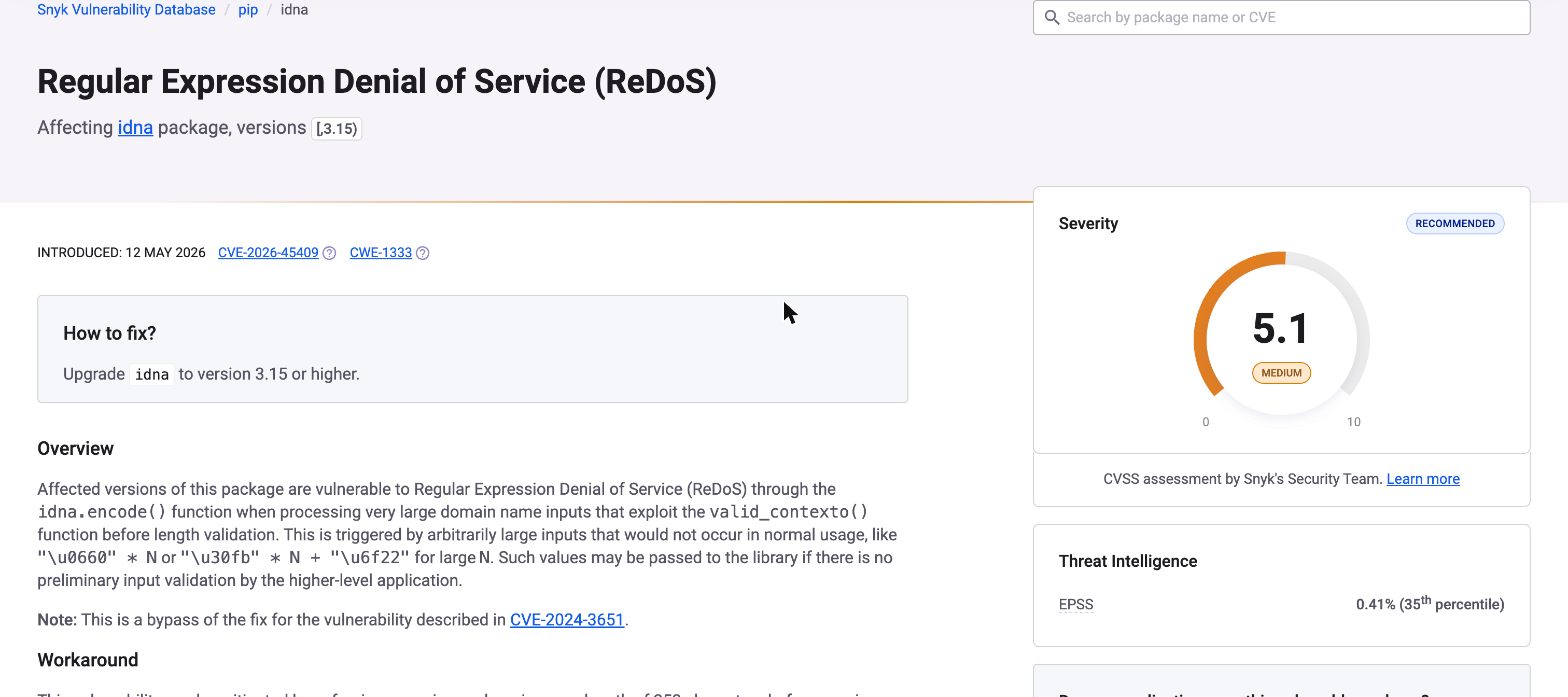
Snyk's Risk Score combines CVSS, exploit maturity, EPSS, advisory age, package popularity, reachability, transitive depth and the business criticality you assign to a project. Reachability is generally available for Java, JavaScript, TypeScript and Python, with the call path shown. Snyk states its own limit: a "No path found" result "does not mean that the element cannot be reached", and the label can change later. Free plan, Team from $25 a month, Enterprise by sales. The plans page does not say which plans include reachability.
Where Reachable Risk differs: Snyk ranks alerts with a score, and the factors behind it sit in a tooltip. A deferral made on a Snyk score is a number in a log, and a reviewer has to rebuild the argument. Reachable Risk returns a verdict per execution context with the reasoning and a NIST SP 800-30 risk assessment written out. Its price is also written out: $10 a month, where Snyk's plans page does not say which plan includes reachability.
5. Endor Labs vs Dependabot
Endor Labs proves each reachable finding with a call graph and each unreachable one with the absence of a path, labelled Reachable, Unreachable or Potentially Reachable. Its pre-computed mode is reachability without a build: Endor reads your manifest, assumes every direct dependency is fully reachable, and uses call graphs it has already computed for the packages themselves to clear transitive dependencies. Your own code is never analyzed. The free tier has no UI, policies or scan history; Core and Pro are priced by sales.
Where Reachable Risk differs: Endor's use-case page says it ranks by reachability with EPSS, fix availability and production context, and its docs show the call path. How those inputs combine, and what a reviewer reads for a deferred finding, is not stated. Reachable Risk publishes how risk is scored, writes the reasoning into each verdict per execution context, and starts at $10 a month with no sales call.
6. Mend SCA vs Dependabot
Mend SCA resolves exploitability on a strongest-match rule across CISA KEV, EUVD and proprietary sources, adds it to the CVSS 4.0 score, and runs call-graph reachability. Converted scores are labelled with their source. Its pages say unreachable findings are "deprioritized" and say nothing about what the reviewer sees for one. Runs on GitHub, GitLab, Bitbucket and Azure DevOps. Pricing is by contact.
Where Reachable Risk differs: Mend's docs do not describe per-finding reasoning. Reachable Risk writes the reasoning into every verdict and starts at $10 a month.
7. Socket vs Dependabot
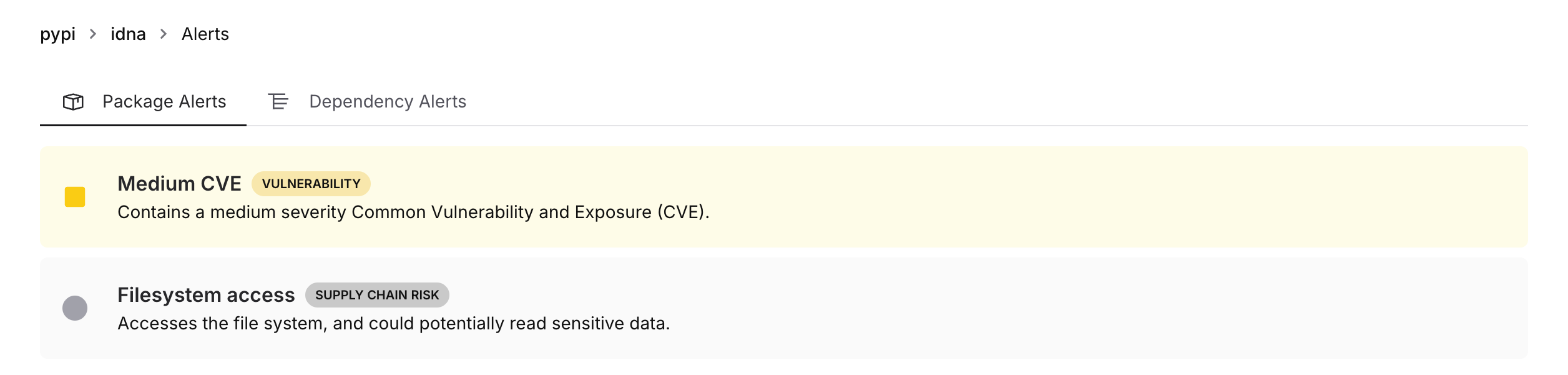
Socket is a supply-chain tool first: install scripts, obfuscated code, privileged API use. CVE prioritization rides along, with severity, EPSS, KEV, priority and a reachability type on each alert, and alert actions (error, warn, monitor, ignore) set by policy. Free plan; Team is $25 a seat a month with "precomputed reachability", a term Socket's pages do not define; function-level reachability across your application is Enterprise only.
Where Reachable Risk differs: If your problem is a malicious package, Socket is the tool. If your problem is 243 alerts about packages you already trust, the reachability that reads your code sits on Socket's Enterprise tier, and Reachable Risk does it starting at $10 a month.
8. JFrog Xray vs Dependabot
JFrog's contextual analysis goes beyond reachability on purpose: about a third of its scanners check configuration, flags, binary symbols or the runtime environment instead, and every result (Applicable, Not Applicable, Undetermined) carries a justification listing the signals checked. Its research team writes scanners mainly for CVEs at CVSS 7.5 and above, so coverage below that line is thinner. It runs in Artifactory, the IDE, the CLI and Frogbot, and Enterprise X starts at $950 a month.
Where Reachable Risk differs: Xray's justifications are the closest thing on this page to a written verdict, and they come with Artifactory, and Enterprise X starts at $950 a month. Reachable Risk gives you the written verdict on Dependabot's alerts starting at $10 a month.
9. GitLab Ultimate vs Dependabot
GitLab's vulnerability report shows KEV status, CVSS, EPSS and reachability, and its Duo false-positive detection explains its confidence. Free and Premium do not include dependency scanning; Ultimate is custom priced. If your code is on GitLab, this is the built-in answer, and Reachable Risk's packaged triage works on GitHub Dependabot alerts today. The same is true for Bitbucket and Azure DevOps readers: Mend, Endor Labs and Snyk cover those platforms, Socket does on Enterprise.
10. Grype, Trivy and OWASP Dependency-Check vs Dependabot
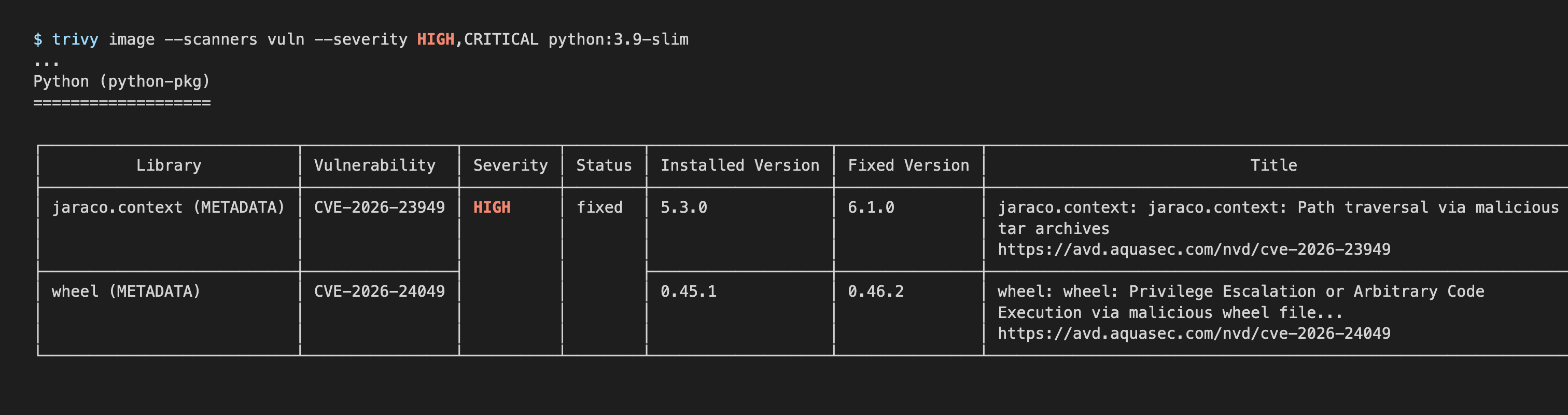
Grype, Trivy and OWASP Dependency-Check are free, Apache-2.0, fast and everywhere in CI. They answer "what vulnerable packages are in this image or tree?" thoroughly. Grype attaches EPSS and KEV and supports OpenVEX for filtering. Trivy filters by severity, status, ignore files, Rego policies and VEX. Dependency-Check matches against the NVD.
Where Reachable Risk differs: Each of these gives you a list and a filter. The risk is still yours to analyze, the verdict yours to write, and the reason a finding was suppressed lives in your VEX file or ignore list. That is fine if you have the time. If you would rather start from alerts already ranked by risk, your coding agent and Reachable Risk do the assessment and write each verdict down.
Dependabot and every alternative on one table
Dependabot, its alternatives, and the tool we sell, compared on the same five criteria:
- Signals: the input signals the tool uses to prioritize alerts.
- Low priority: what happens to an alert or pull request the tool rates as low risk.
- Reasoning: whether a person can read why the alert is prioritized that way.
- Platforms: where the tool runs and what it supports.
- Price: what the prioritization capability costs, from the vendor's own documentation or pricing page, read on the Updated date at the top of this page. "Not stated" means the vendor's pages do not say.
| Product | Signals | Low priority | Reasoning | Platforms | Price for prioritization |
|---|---|---|---|---|---|
| Dependabot | Severity, EPSS, dependency scope. Reachability in public preview: JavaScript and TypeScript only, GitHub Enterprise Cloud repositories only. KEV not stated. | Every alert with a patch gets a pull request. Alerts stay open until fixed or dismissed. | Auto-dismissals are tagged resolution:auto-dismiss. Reachability preview shows a call path. No per-alert reasoning otherwise. |
GitHub. | Alerts, updates and GitHub's preset rules are free. Custom auto-triage rules are free on public repositories; on private ones they need GitHub Code Security on Team or Enterprise. |
| Dependabot, configured | Same signals. Custom rules match metadata: severity, package name, CWE, scope. | Rules auto-dismiss or snooze; groups combine PRs; open-pull-requests-limit: 0 stops version-update PRs. Dismissals take one of five reasons plus an optional comment. |
The dismissal reason and comment. A rule gives no reason beyond matching. | GitHub. | Presets free. Custom rules free on public repositories, GitHub Code Security on private ones. |
| Renovate | Reads GitHub's alerts and OSV. Severity, CVSS, EPSS, KEV, reachability: not stated. Merge Confidence scores package age, adoption and test results, not vulnerabilities. | Vulnerability PRs "skip the line" past schedules and limits by default. Other updates can be grouped, scheduled, delayed or automerged. | Dependency Dashboard lists every PR. Merge Confidence algorithm is private. | GitHub, GitLab, Azure, Bitbucket, Gitea, Forgejo and more. | CLI and Community edition free. Enterprise: contact Mend. |
| Snyk | Risk Score from CVSS, exploit maturity, EPSS, advisory age, package popularity, reachability, transitive depth, business criticality. Reachability GA for Java, JavaScript, TypeScript, Python. KEV not stated. | Reachability is a filter. Automatic dismissal: not stated. | Score tooltip lists the factors. Call path shown. Snyk's own caveat: "No path found" does not mean unreachable. | GitHub, GitLab, Bitbucket, Azure Repos. | Free $0. Team from $25 a month. Enterprise: contact sales. Reachability plan gating: not stated. |
| Mend SCA | CVSS 4.0, EPSS, CISA KEV and EUVD on a strongest-match rule, call-graph reachability. | Unreachable findings "deprioritized". Builds can be gated on policy. | Converted scores labelled with their source. Per-finding reasoning: not stated. | GitHub, GitLab, Bitbucket, Azure DevOps. | Contact Mend. |
| Endor Labs | Function-level and dependency-level reachability from call graphs; pre-computed reachability without a build for Java, JavaScript, TypeScript, Kotlin, Python, Scala, C#. EPSS, KEV: not stated. | Findings labelled Reachable, Unreachable, Potentially Reachable. | A call graph for each reachable finding, or the absence of one. | GitHub, GitLab, Bitbucket, Azure DevOps, on-premises. | Free tier with no UI. Core and Pro: contact sales. |
| Socket | Per-alert severity, EPSS, KEV, priority and reachability type. Core strength is behavioural supply-chain detection. | Alert actions: error, warn, monitor, ignore, by policy. | Pull request comments. | GitHub; GitLab, Bitbucket, Azure DevOps on Enterprise. | Free $0. Team $25 a seat a month with precomputed reachability. Function-level reachability on Enterprise only. |
| Grype | EPSS, KEV, risk scoring. Reachability: not stated. | OpenVEX filtering. | Not stated. | CLI. | Free, Apache-2.0. |
| Trivy | Vendor severity, CVSS bands. EPSS, KEV, reachability: not stated. | Severity, status, ignore files, Rego policies, VEX. | Not stated. | CLI. | Free, Apache-2.0. |
| OWASP Dependency-Check | NVD matching. | Not stated. | Not stated. | CLI, Maven, Gradle, Ant. | Free, Apache-2.0. |
| JFrog Xray | Contextual analysis: reachability, binary symbols, configuration, flags, runtime; a third of its scanners do not rely on reachability. Scanners exist mainly for CVSS 7.5 and above. | Applicable, Not Applicable, Undetermined. | A justification for every result, with the signals checked. | Artifactory, IDE, CLI, Frogbot. | Enterprise X from $950 a month. |
| GitLab | KEV, CVSS, EPSS, reachability in the vulnerability report. | Statuses; Duo false-positive detection. | Duo's confidence score and explanation. | GitLab. | Ultimate: custom pricing. |
| Reachable Risk (k9) | Reachability from your coding agent with a named basis; KEV and EPSS from k9; asset context you declare. Severity recorded, not an input. | A verdict per alert per execution context: Fix Today, Review, Schedule, Defer. Floors keep KEV-listed, ransomware, tier-1 and public-asset alerts off Defer. | Every verdict returns its rationale, three factors with confidence, the floors it triggered, and the evidence. | MCP server for Claude Code and other agents; GitHub Action. | $10 a month, 1,000 alerts, 7-day trial. |
Having reachability does not separate the rows; eight of these tools have some form of it. Three things do: whether exploitation evidence and asset context join reachability in one verdict, whether the reasoning behind a deferral is written somewhere a reviewer can check it, and what it costs to get there.
How and when to ignore Dependabot alerts
Whichever tool you pick, some alerts get ignored. "Ignore" covers five different actions in Dependabot, and they stop different things:
| Mechanism | What it stops | What it does not stop |
|---|---|---|
| Dismiss an alert (reason + comment) | That one alert, for that advisory and manifest | New alerts for other advisories in the same package; a dismissed alert can be reopened |
| Auto-triage rule | Matching alerts before anyone is notified | Alerts outside the rule's metadata; the rule reopens an alert whose metadata changes |
ignore in dependabot.yml |
Version-update PRs for the named dependency, version or semver level | Alerts (no interaction with alerts per GitHub's docs) |
open-pull-requests-limit: 0 |
Version-update PRs for the ecosystem | Alerts and security-update PRs |
| Disable security updates | Pull requests for alerts | Alerts themselves |
The five dismissal reasons GitHub records are fix_started, inaccurate, no_bandwidth, not_used and tolerable_risk, with an optional comment. Three of those, not_used, tolerable_risk and inaccurate, are judgments about risk, and the comment is where the judgment goes.
The rule we use, and recommend: ignore a specific alert, for a stated reason, with a date to look again. Never ignore a dependency to make it quiet. The reason records one of three facts: the vulnerable code does not run in this context (reachability), nobody is exploiting it and the forecast is low (exploitation evidence), or the thing it sits in cannot do much harm (asset context). If you cannot state one of the three, the alert is not ignorable. It needs an engineer to review it in the context of the deployed application, which is the work Reachable Risk is built to do. If the question that brought you here was "which of these alerts actually matters?", point your agent at your repository and read the answers.
Wrap-up
We built Reachable Risk after too many afternoons wasted remediating alerts rated 'Critical' that, once we looked, carried no material risk in our code.
So keep Dependabot, and point your coding agent with Reachable Risk at the alerts. Each one comes back with an actionable verdict, the evidence behind it, and a risk assessment you can hand to a reviewer. Then your afternoon goes to the alerts that present real risk in your code, and the fixes that ship (actually) make the software more secure.
Reachable Risk Professional is $10 a month for 1,000 alerts. There is no sales call.